Single Consent Source of Truth
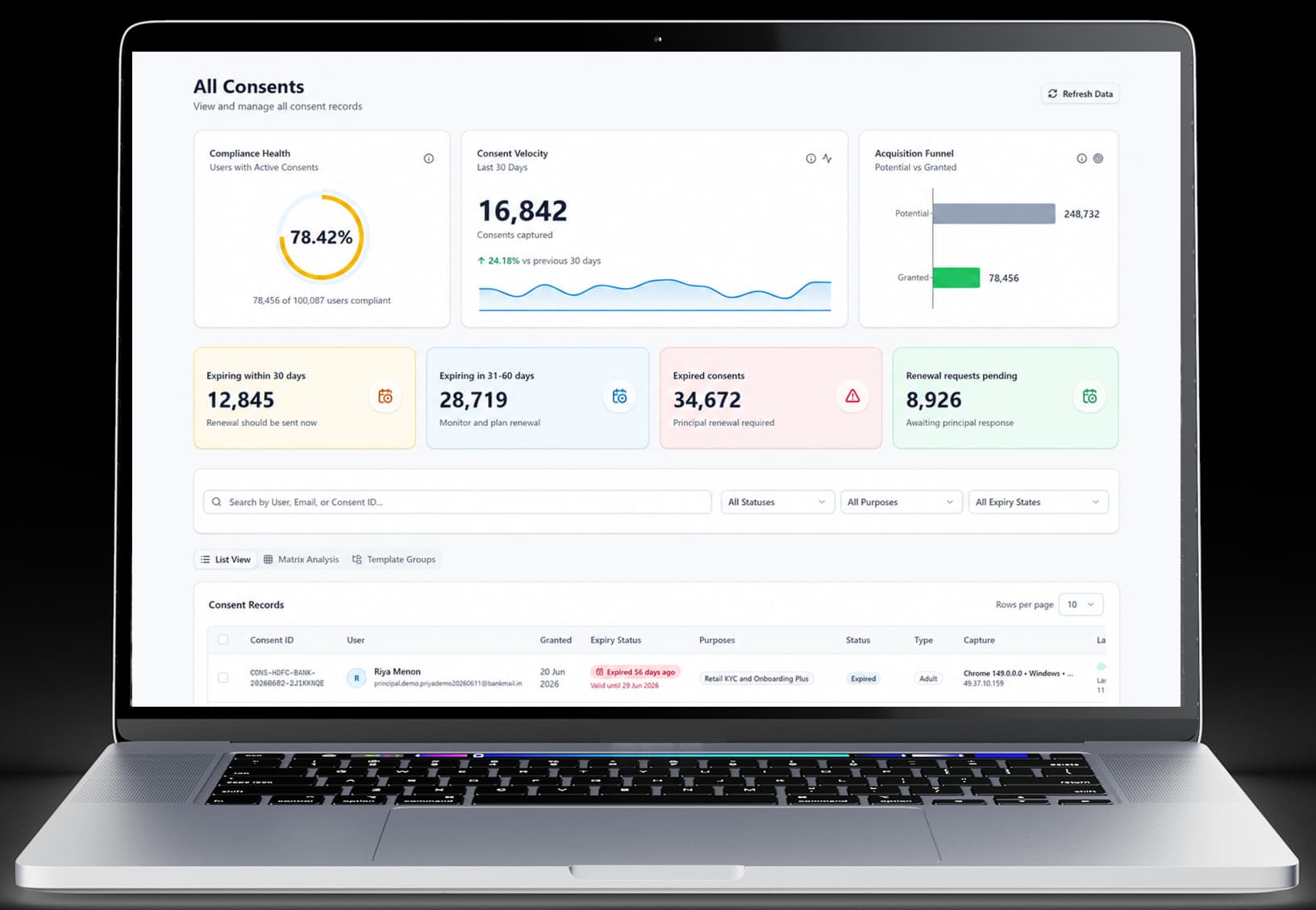
Normalize fragmented records from web, app, CRM, and partner channels into one ledger for consent lifecycle management.
Move from scattered consent records to one auditable operating layer across web, app, API, and offline journeys.
Most enterprises are not failing because they lack a banner. They fail because consent state, purpose mapping, and withdrawal propagation are fragmented across systems. AquaConsento gives legal, product, and engineering one operational source of truth with evidence you can defend.
Best for teams that need a practical path to auditable consent controls without a full platform re-write.
At A Glance
Evidence Focus
Under the DPDP Act, businesses need clear, traceable consent records to support DPDP compliance — not just a checkbox buried in a privacy policy.
A consent management system captures, stores, updates, and enforces those consent records across every channel your business touches: websites, mobile apps, CRM tools, third-party partners, and offline touchpoints. Think of it as your single source of truth for "did this person say yes, and can I prove it?"
 01 / 03
Short answer: it is the operating system for capturing, updating, and withdrawing purpose-level consent with auditable evidence across all channels.
Each outcome maps to execution, ownership, and proof — not abstract policy language.
Normalize fragmented records from web, app, CRM, and partner channels into one ledger for consent lifecycle management.
Standardize consent updates and withdrawals with enforceable SLAs and complete downstream propagation evidence.
Generate structured logs, version history, and control evidence for legal, privacy, and internal audit teams.
Most delays come from operating-model gaps, not tooling gaps. Teams move faster when ownership, policy, architecture, and evidence align before implementation begins.
Without unified user consent management, teams store decisions in separate CRM, product, and marketing tools, making one authoritative state hard to prove.
Legal language often says one thing, while product and engineering systems behave differently in edge cases such as revocation, re-consent, and DPDP consent manager workflows.
When consent changes, downstream systems and vendors are not consistently updated with verifiable proof.
Evidence gets stitched manually right before reviews, creating risk and delays during regulatory scrutiny.
Bring legal, product, engineering, and operations into one consent operating model with clear ownership and evidence.
Teams coordinating consent across high-volume, multi-system customer journeys.
Move from consent-system discovery to live lifecycle controls through a focused, evidence-led delivery path.
Consent system inventory, purpose map, and owner matrix finalized.
Identify where consent is captured, updated, consumed, and overwritten across products, channels, and processors.
Deploy centralized controls and event contracts without forcing risky legacy rewrites.
Operationalize consent lifecycle management with downstream propagation, fallback handling, verification, and traceable acknowledgements.
Test evidence retrieval, exception handling, and grievance workflows before regulator scrutiny.
Align legal, product, engineering, and operations around the consent lifecycle outcomes each team owns.
Without a unified operating model
Cross-channel consent orchestration
Often fragmented by channel or tool
Withdrawal propagation proof
Manual confirmations, weak traceability
DPDP-focused control mapping
Generic privacy workflows needing rework
AquaConsento operating model
Cross-channel consent orchestration
Native across web, app, API, and offline
Withdrawal propagation proof
Built-in event evidence and SLA tracking
DPDP-focused control mapping
DPDP-first operating model and evidence packs
Get practical answers about consent records, lifecycle controls, integrations, and audit evidence before you plan the next implementation step.
A consent management system helps businesses collect, store, update, withdraw, and audit user consent across websites, apps, APIs, CRM systems, and offline journeys. Under DPDP, it should maintain purpose-level consent records, consent history, withdrawal status, and evidence that can be reviewed by legal, compliance, product, and audit teams.
Use these linked pages together to cover strategy, controls, implementation, and evidence.

September 2026 · 8 min read

September 2026 · 7 min read

September 2026 · 6 min read
September 2026 · 8 min read
September 2026 · 7 min read
September 2026 · 6 min read
September 2026 · 8 min read
September 2026 · 7 min read