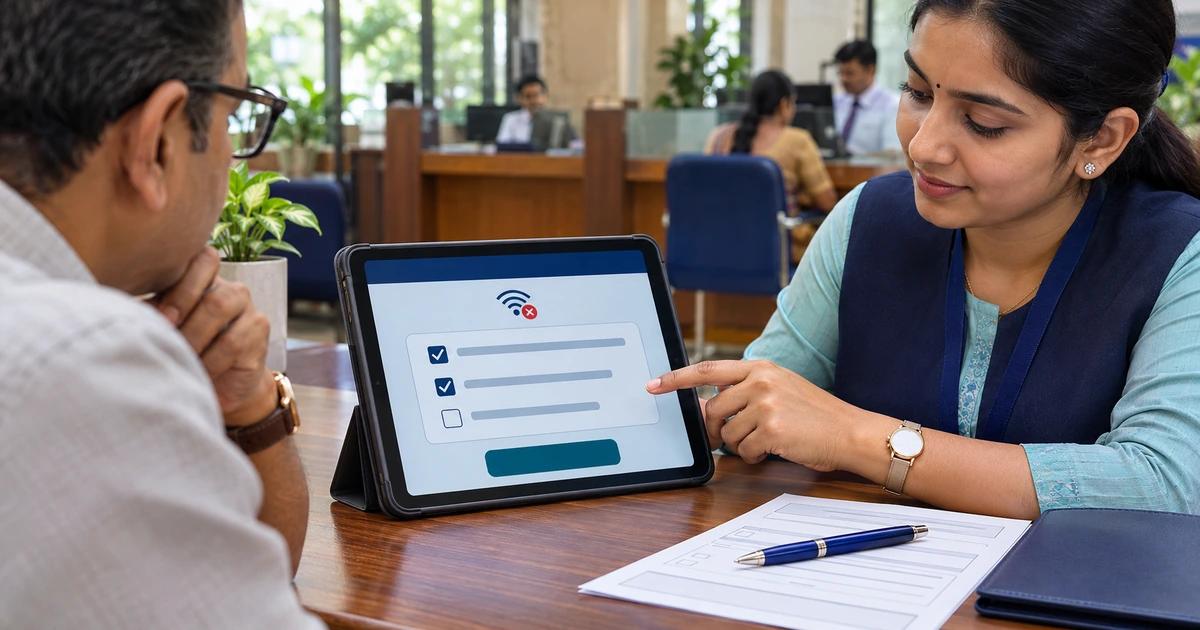
A customer is halfway through an assisted journey at a bank branch when the network disappears. The employee can still see the application on the tablet, the customer can still review the consent information, and the device can record a choice locally. What the central system cannot do is see that choice immediately.
That temporary gap changes the problem. A reliable consent management platform should not treat reconnection as a simple upload of the latest value stored on the device. It needs to preserve when the customer acted, which purpose and notice were presented, who the event belongs to, whether another channel recorded a later action, and how the final consent state was reconciled.
For enterprises with branches, field teams, kiosks or assisted channels, offline consent is therefore less about “offline mode” and more about preserving customer intent until every system can agree on what actually happened.
The difficult part starts after the branch reconnects
Imagine that the branch loses connectivity at 11:08 a.m. At 11:13 a.m., the customer reviews the consent journey and agrees to receive account-service communications but declines promotional messages. Because the tablet is offline, both choices remain locally queued.
Five minutes later, the customer opens the bank’s mobile application, which still has connectivity. There, the customer changes the promotional preference again. The branch connection finally returns at 11:26 a.m., and its locally stored event is ready to synchronise.
The central platform now has two legitimate pieces of history. One was created earlier but arrived later. The other was created later but reached the central platform first.
If the system simply accepts whichever update reaches the server last, it can turn a network condition into an incorrect consent state.
That is why offline consent should be handled as a sequence of events, not as competing database values.
An offline consent record needs the context behind the choice
Recording only consent = yes or consent = no is not enough for a resilient consent architecture.
When the branch reconnects, the platform needs enough information to understand the event without relying on the memory of the employee who captured it. That means preserving the customer or Data Principal identifier, purpose, consent state, capture time, originating channel, notice or template version and a stable event identifier that survives retries.
A practical record might look like this:
| Context retained | Why it matters after reconnection |
|---|---|
| Data Principal identifier | Connects the event to the correct person |
| Purpose identifier | Establishes what the choice applied to |
| Consent state | Records grant, refusal, change or withdrawal |
| Capture timestamp | Shows when the person actually acted |
| Channel/device | Identifies where the event originated |
| Notice/template version | Preserves what was presented |
| Event ID | Prevents the same action being processed twice |
| Synchronisation status | Shows whether the event reached the central system |
This is an implementation model, not a statutory DPDP record format. The distinction matters because the DPDP Act does not prescribe this particular technical schema.
The governance rationale is still important. The Digital Personal Data Protection Act, 2023 establishes requirements around valid consent and places the burden of proving that notice and consent requirements were met on the Data Fiduciary where consent is relied upon. Those substantive consent provisions are part of the later commencement tranche currently scheduled for 13 May 2027.
For teams preparing their consent operations, preserving context now is considerably more useful than trying to reconstruct it after a dispute.
Capture time and synchronisation time should never be confused
The bank’s branch event was captured at 11:13 a.m. but did not reach the platform until 11:26 a.m. Those times describe different things and should remain separate.
The capture timestamp tells the organisation when the customer acted. The synchronisation timestamp tells Engineering when the infrastructure became aware of that action.
Conflating the two can distort the consent history.
Suppose the customer’s mobile change happened at 11:18 a.m. If the branch upload is recorded only as an event created at 11:26 a.m., the central system may incorrectly conclude that the branch choice is newer and overwrite the mobile decision.
For enterprises evaluating a consent management platform, this is a worthwhile resilience test. Ask whether an offline event retains its original event time after reconnecting, rather than inheriting the time it happened to reach the server.
That difference sounds small until a conflict has to be explained.
Reconnection should replay history, not overwrite it
A resilient reconnect flow should preserve events and let the central platform determine their relationship.
The operational journey can be thought of as:
Offline capture → protected local queue → reconnect → identity validation → event replay → conflict review → reconciled state → evidence
The branch tablet first captures the action with its original context. While connectivity is unavailable, the event remains queued locally rather than pretending it has already reached the enterprise consent record.
When the device reconnects, the queued event is submitted to the central environment. The platform validates identity and event context before adding the event to the history.
Only then should reconciliation occur.
In the bank scenario, the platform can see that the branch event happened at 11:13 a.m., the mobile event happened at 11:18 a.m., and the branch event merely arrived at 11:26 a.m. Both events can remain visible even though only one represents the latest customer state.
This preserves chronology instead of letting network timing rewrite it.
Repeated reconnect attempts should not create repeated consent events
Real branch connectivity is rarely as neat as a diagram suggests. A connection may return for a few seconds, disappear again, and recover later.
Imagine the branch tablet submits the queued event at 11:26 a.m. The server processes it, but the connection drops before the device receives confirmation. At 11:29 a.m., the tablet tries again.
If the central system treats that retry as a second customer action, the audit history now contains two consent events even though the customer acted only once.
The usual engineering control is idempotency: the offline action receives a stable event identifier, and repeated submissions of that same identifier do not create additional customer decisions.
This is a distributed-systems principle rather than a privacy-law requirement, but it has direct governance value. A consent history should represent what the person actually did, not how many times an unreliable connection retried the payload.
A withdrawal deserves more care than an ordinary preference update
The same branch scenario becomes more sensitive if the offline action is a withdrawal rather than a new grant.
Suppose the customer withdraws a marketing consent at 2:05 p.m. while the branch is offline. The central system does not receive the withdrawal until 2:40 p.m.
For a period of time, the branch and the central platform contain different states.
The DPDP Act’s withdrawal provisions state that a Data Principal may withdraw consent and, subject to the Act’s conditions, the Data Fiduciary must cease or cause processors to cease processing based on that consent. Most of those substantive Section 6 provisions are scheduled to commence on 13 May 2027 under the current commencement notification.
For readiness, the practical lesson is straightforward: do not replace the original withdrawal time with the later synchronisation time.
The organisation should be able to distinguish when the person expressed the withdrawal from when the network delivered it.
That creates a more truthful operational record and makes later investigation far easier.
Notice version becomes especially important when devices go offline
Offline channels can continue operating with stale configuration.
A branch tablet may have downloaded Notice v7 in the morning. While the device is disconnected, the central environment moves to Notice v8. The customer then makes a choice against the version still available on the tablet.
That event should not disappear merely because a newer template exists centrally.
The platform should preserve the version that the customer actually encountered and flag version discrepancies where the organisation’s governance rules require review.
The final Digital Personal Data Protection Rules, 2025 specify that notices under Rule 3 should be independently understandable and include an itemised description of personal data and the specified purpose. Rule 3 is scheduled to come into force eighteen months after the Rules were published, which places commencement on 13 May 2027.
For implementation teams, the practical point is not to label a pre-commencement version mismatch automatically “non-compliant.” It is to preserve enough version evidence that Privacy and Legal can understand exactly what was presented when the event occurred.
Conflict resolution should explain the final state instead of hiding the history
Now return to the bank customer.
The full chronology is:
| Event | Time |
|---|---|
| Branch loses connectivity | 11:08 |
| Customer chooses promotional consent in branch | 11:13 |
| Customer later withdraws in mobile app | 11:18 |
| Branch reconnects | 11:26 |
| Offline event reaches central platform | 11:26 |
A weak implementation could interpret the branch upload as the latest update because it arrived last.
A stronger implementation sees that the branch event happened first.
The central state can therefore continue to reflect the 11:18 withdrawal while retaining the earlier branch event as part of the history.
A useful reconciliation record would preserve the two event IDs, their original timestamps, the associated purpose, identity match, version context and the reason the later customer action remained authoritative.
That is more valuable than simply storing current_status = withdrawn.
Months later, a Privacy reviewer can understand not only what the final state was, but how the system reached it.
Identity uncertainty should stop automatic reconciliation
Connectivity loss can affect identity services as well as consent APIs.
A branch employee may be working with a cached profile. A field application may know a customer through a temporary local identifier before the central identity service confirms the match.
If an offline event reconnects and the platform cannot confidently map it to the correct person, automatically attaching it to an existing consent history is risky.
A safer design is to preserve the event but hold it for reconciliation until identity can be established.
That might mean an automated secondary match or an authorised manual review, depending on the system design.
The principle is simple: uncertainty should remain visible.
It is better to have a pending consent event that requires resolution than a confidently recorded choice attached to the wrong individual.
The best offline test begins after connectivity returns
An enterprise evaluating offline capture should not stop after confirming that a form works without Wi-Fi.
That proves only that the application can save something locally.
A meaningful platform test recreates the messier sequence the bank experienced. Capture a choice offline, create another consent event through a working channel, reconnect the branch application and retry the queued event more than once. Introduce an older notice version and, if the system supports it, test an uncertain identity match.
Then inspect what the platform records.
You should be able to tell when the customer acted, when the event synchronised, which purpose and notice applied, whether a duplicate replay was suppressed, whether a conflict existed and why one state ultimately became authoritative.
That is a considerably better evaluation of resilience than asking whether “offline consent” appears in a feature list.
For a consent management platform in India, the test is particularly relevant where consent journeys extend beyond digital-first web and mobile experiences into bank branches, insurance agents, field sales, assisted onboarding and other environments where connectivity cannot always be assumed.
A central platform is useful when channels contribute to one explainable history
AquaConsento’s current platform describes consent capture across web, mobile, API, assisted and embedded journeys, together with template governance, lifecycle tracking, audit evidence and integration controls.
For enterprises operating across those kinds of channels, an enterprise platform for governing consent across connected channels is most useful when each channel contributes to one reviewable consent history rather than maintaining an isolated version of customer intent.
Offline resilience should fit that operating model.
The objective is not to pretend every endpoint will remain connected. Real enterprise environments include branches with unstable networks, field teams moving between coverage areas, devices that retry requests and systems that occasionally disagree.
The more useful design goal is that temporary disconnection should not destroy chronology, notice context, identity or evidence.
Offline consent resilience is really about preserving customer intent
The technical task is to reconnect a device. The harder governance task is to ensure that the consent history still reflects what the customer actually did once that connection returns.
That requires more than queueing a form submission.
A resilient consent management platform should preserve original event context, separate capture time from synchronisation time, prevent duplicate replay, identify conflicts and retain enough evidence to explain the resulting consent state.
For enterprises comparing a consent management platform in India, offline reconciliation deserves to sit alongside ordinary considerations such as APIs, lifecycle management, template governance and audit evidence.
The branch may be offline for twenty minutes.
The meaning of the customer’s decision should not be.
Frequently Asked Questions
Can consent be captured while a branch or field application is offline?
From a technical perspective, an application can preserve a consent event locally and submit it after connectivity returns. The organisation still needs an appropriate legal and operational design for the underlying processing. A resilient implementation should preserve the original purpose, notice context, identity and event time rather than treating reconnection as a new customer action.
Which timestamp should a consent management platform use after reconnection?
Both event time and synchronisation time have value. Event time records when the person actually made the choice, while synchronisation time records when the central platform received it. Keeping them separate prevents network delay from changing the apparent order of customer decisions.
What should happen when an offline consent conflicts with a newer online event?
Both events should remain part of the history. The platform should reconcile them using defined rules based on factors such as original event time, identity, purpose and applicable version context rather than simply allowing the last-arriving payload to overwrite the earlier history.
How can duplicate consent records be avoided when a device reconnects repeatedly?
A stable event identifier can make replay idempotent. If the same offline event is submitted several times because connectivity is unreliable, the central platform can recognise that it has already processed that customer action instead of generating additional consent events.
Why should the notice version be stored with an offline consent event?
The version helps the organisation determine what information and purpose context the individual actually encountered when making the decision. This is particularly useful when a disconnected device is operating with an older template than the central platform.
Offline capture should therefore be treated as a lifecycle problem rather than a standalone form feature. When reconnection is designed around chronology, identity, version context and evidence, temporary network loss does not need to become permanent uncertainty about what the customer chose.